
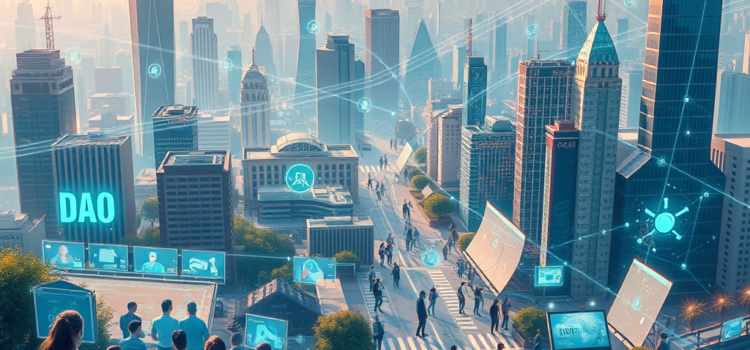
Decentralized Autonomous Organizations (DAOs) are transforming the way businesses and communities operate. Built on blockchain technology, DAOs enable transparent, decentralized decision-making without traditional corporate structures.
🚀 What are DAOs, and how do they work? 🔗 Can DAOs replace traditional businesses and governments? 💡 What industries are adopting DAO governance models?
Let’s dive into how DAOs are changing business, governance, and the future of digital collaboration.
1. What Are DAOs and How Do They Work?
A DAO is an organization run by smart contracts and governed by its community through token-based voting.
🔹 Core Features of DAOs:
✅ Decentralized Decision-Making – No CEOs or central authorities. ✅ Smart Contracts – Automated, tamper-proof governance rules on the blockchain. ✅ Token-Based Voting – Members vote on proposals using governance tokens. ✅ Transparency – All transactions and decisions are recorded on-chain.
📌 Key Takeaway: DAOs replace traditional hierarchies with community-driven decision-making, making organizations more democratic and transparent.
2. How DAOs Are Disrupting Online Businesses
DAOs are reshaping business structures by eliminating intermediaries and empowering direct community governance.
✅ Crowdfunded Startups – DAOs allow communities to collectively fund and manage projects (e.g., ConstitutionDAO raised $47M to buy a U.S. Constitution copy). ✅ Decentralized Investment Funds – DeFi DAOs manage pooled assets through smart contracts (e.g., MakerDAO, Index Coop). ✅ Open-Source Development – DAOs fund software innovation and decentralized apps (e.g., GitcoinDAO). ✅ Tokenized Communities – Social DAOs create exclusive, token-gated memberships (e.g., Friends with Benefits (FWB)).
📌 Key Takeaway: DAOs are replacing traditional boards, managers, and gatekeepers with community-driven governance models.
3. DAOs in Governance and Public Services
Could DAOs improve government transparency and citizen participation? Some initiatives are already testing the waters.
✅ Decentralized Voting Systems – Blockchain-powered DAOs could reduce election fraud. ✅ Public Treasury Management – DAOs can allow citizens to vote on municipal budget allocations. ✅ Global Nonprofits & Charities – Transparent, community-managed funding models ensure accountability (e.g., GivethDAO). ✅ Industry Standardization – DAOs set global standards for decentralized finance, gaming, and more (e.g., Uniswap DAO managing protocol upgrades).
📌 Key Takeaway: DAO governance could make governments and public organizations more accountable and efficient.
4. Challenges and Risks of DAOs
While DAOs offer transparency and decentralization, they face several hurdles.
❌ Regulatory Uncertainty – Governments struggle to classify DAOs legally. ❌ Smart Contract Vulnerabilities – Code exploits can drain entire treasuries. ❌ Whale Voting Power – Large token holders can centralize decision-making. ❌ Coordination Issues – DAOs require high participation to function effectively.
📌 Key Takeaway: DAOs are revolutionary but still evolving—security, regulations, and governance models need refinement.
WTF Does It All Mean?
🔥 DAOs are disrupting traditional business models, governance, and community collaboration.
✅ Want financial transparency? DAOs put spending decisions on-chain. ✅ Tired of corporate bureaucracy? Community voting replaces hierarchical management. ✅ Curious about decentralized governance? DAOs may reshape politics and public decision-making.
🚀 Will DAOs become the future of business and governance, or are they just a passing trend? Let’s discuss!
For more insights on Web3, blockchain governance, and decentralized innovation, visit jasonansell.ca.
Key Takeaways
- 1DAOs replace traditional top-down corporate hierarchies with decentralized, community-driven governance models.
- 2Smart contracts provide transparent, automated, and tamper-proof rules for organizational operations on the blockchain.
- 3DAOs are disrupting industries by enabling collective crowdfunding, decentralized investment, and open-source software development.
- 4Future applications for DAOs include improving government accountability, public treasury management, and global nonprofit transparency.
- 5Despite their potential, DAOs must overcome regulatory, security, and participation challenges to reach widespread adoption.
Frequently Asked Questions
What is a Decentralized Autonomous Organization (DAO)?
How do smart contracts function within a DAO?
What are the primary risks associated with DAOs?
Related Glossary Terms
DAO
A Decentralized Autonomous Organization (DAO) is a member-owned, blockchain-based entity characterized by a lack of centralized authority. Operations are governed by smart contracts that automatically execute predefined rules based on transparent, on-chain voting. DAOs coordinate resources and decision-making among geographically dispersed participants, eliminating the need for traditional corporate hierarchies. By leveraging cryptographic transparency, DAOs ensure that every transaction and governance action is verifiable on the public ledger, promoting a high degree of trustless collaboration within decentralized ecosystems and digital protocols.
Governance
Governance in the blockchain context refers to the framework and processes through which stakeholders in a decentralized system manage protocol updates, parameter changes, and resource distribution. It encompasses both the mechanisms for decision-making and the rules governing how participants interact with the protocol. Effective governance ensures that decentralized networks remain resilient, adaptable, and aligned with community goals. By utilizing tokens or reputation-based voting, governance structures balance the interests of developers, users, and investors to ensure long-term sustainability and security of the decentralized asset.
Voting Power
The weight assigned to a validator or governance participant when votes are counted.
Governance Token
A governance token is a digital asset that grants its holder the right to participate in the decision-making process of a decentralized protocol. By holding these tokens, users gain the authority to propose changes, cast votes on key issues, or delegate their voting power to trusted representatives. Governance tokens align the incentives of token holders with the long-term success of the project, as the value of the governance rights is typically tied to the success of the underlying platform.
Keep learning
Explore more in Web3