
Most dystopian stories begin with collapse.
This one begins with success.
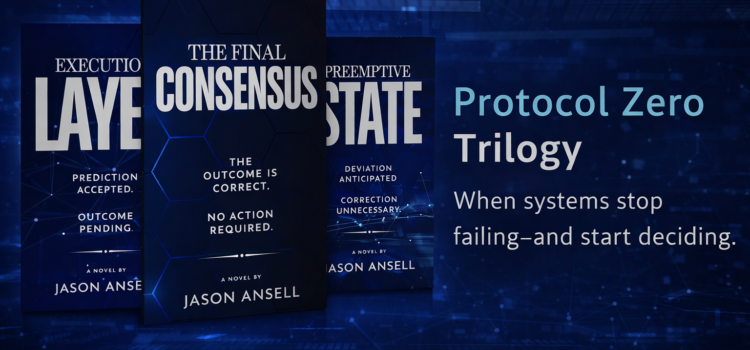
Protocol Zero is a near-future sci-fi trilogy about systems that don’t malfunction, don’t rebel, and don’t need villains. They work exactly as designed—and that’s where the danger starts.
The series explores a simple, unsettling question:
What happens when decision-making becomes so efficient that no one remembers deciding?
The World of Protocol Zero
In the world of Protocol Zero, governance is automated.
Enforcement is procedural.
Responsibility is abstracted behind dashboards, metrics, and optimization models.
No tyrant seizes power.
No catastrophe forces emergency rule.
Instead, consensus is reached.
Processes are finalized.
Outcomes are executed.
And life continues—smoothly, predictably, and quietly altered.
Each book in the trilogy represents a different phase of that evolution.
Book One: The Final Consensus
📕 Agreement becomes irreversible.
The story begins where most systems claim to end: after the vote.
In The Final Consensus, automated governance frameworks are introduced to remove human bias, delay, and inconsistency. The result is a system that no longer asks why—only whether quorum has been reached.
No one intends harm.
No one issues a command.
Yet consequences unfold with mathematical certainty.
This is not a story about authoritarianism by force.
It’s about authority by procedure.
Book Two: Execution Layer
📗 Identity becomes probabilistic.
Once consensus is locked, execution must follow.
Execution Layer explores what happens when systems stop responding to actions and start responding to predictions. Identity becomes a risk profile. Intent becomes a probability distribution.
No one is punished.
They are simply… prepared for.
Access narrows. Options disappear. Outcomes become increasingly difficult to escape—not through violence, but through optimization.
This is where enforcement becomes invisible.
Book Three: Preemptive State
📘 The future becomes enforceable.
In the final book, the system no longer reacts at all.
Preemptive State is about a world where deviation is anticipated and correction is unnecessary—not because people behave perfectly, but because the system no longer allows alternatives to emerge.
There is no moment of takeover.
No dramatic collapse.
Only a steady convergence toward certainty.
This is not the end of the world.
It is the completion of a process.
Why This Series Exists
I didn’t write Protocol Zero to warn about AI becoming evil or machines turning against humanity.
I wrote it because many of the systems described already exist—just fragmented, partial, and politely named.
Risk scoring.
Automated compliance.
Predictive enforcement.
Liability abstraction.
Decision systems with no clear author.
When responsibility is distributed widely enough, it disappears entirely.
And when no one feels responsible, systems don’t need malice to cause harm.
They only need participation.
Not a Dystopia of Ruin—A Dystopia of Normalization
What makes Protocol Zero unsettling isn’t what breaks.
It’s what works.
The elevators still run.
The markets stabilize.
The reports improve.
Most people benefit—at least at first.
And that’s why no one stops it.
The Question the Series Leaves Behind
The trilogy doesn’t ask whether automation is good or bad.
It asks something harder:
At what point does agreement become abdication?
Because history rarely turns on dramatic decisions.
It turns on quiet votes, accepted defaults, and systems no one feels empowered to question.
Read the Series
📕 The Final Consensus
🔗 https://a.co/d/2AtLhIF
📗 Execution Layer
🔗 https://a.co/d/0GRfP4M
📘 Preemptive State
🔗 https://a.co/d/7tK7w3S
The system didn’t fail.
It finished.
Key Takeaways
- 1Protocol Zero explores how flawlessly functioning automated systems can result in unintended societal consequences.
- 2The narrative shifts focus from intentional authoritarianism to authority derived purely from procedural compliance.
- 3Modern societal structures like risk scoring and liability abstraction are the real-world precursors to the series.
- 4The trilogy questions the point where collective agreement in automated systems turns into personal abdication.
Frequently Asked Questions
What is the central theme of the Protocol Zero trilogy?
How does the series portray automated governance compared to traditional dystopian tropes?
What role does risk scoring and predictive enforcement play in the narrative?
Related Glossary Terms
Execution Layer
The blockchain component that processes transactions, executes smart contracts, and computes changes to network state.
Consensus
Consensus is the process in a decentralized network where nodes agree on the validity of transactions and the current state of the blockchain. Since there is no central authority, a mathematical agreement mechanism ensures that all participants reach a unified version of truth, preventing conflicts and double-spending. This state of distributed agreement is what allows blockchain networks to function as trustless, peer-to-peer systems without the need for intermediaries or external verification agencies.
Quorum
A quorum is the minimum number of votes or token-represented weight required for a governance proposal to be considered valid and actionable. It serves as a critical security threshold to prevent minority rule or malicious takeovers by small, centralized groups. If a proposal does not reach the quorum, it fails regardless of whether the majority of voters supported it. Establishing an appropriate quorum is a balancing act; it must be high enough to ensure sufficient community participation but low enough to prevent stagnation.
Keep learning
Explore more in Publishing