
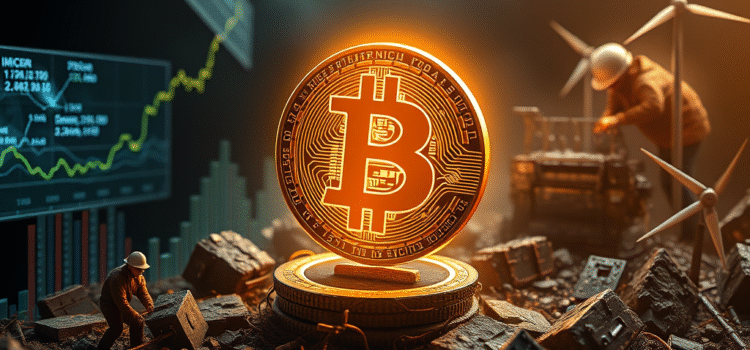
The fourth Bitcoin halving took place in April 2024, marking another milestone in the world’s most famous monetary experiment.
Every four years, Bitcoin cuts its block rewards in half — a built-in supply shock that reduces the rate at which new BTC enters circulation.
It’s part of what makes Bitcoin unique — and why every halving has historically triggered a new bull cycle.
Now that the latest halving is behind us, investors are asking one big question:
What comes next — and is 2025 shaping up to be the start of another major bull run?
⛏️ What Happened in the 2024 Halving
The April 2024 halving reduced block rewards from 6.25 BTC to 3.125 BTC, cutting the daily issuance of new Bitcoin from around 900 BTC to 450 BTC.
Halving Year
Block Reward
BTC Created Daily
Market Outcome
2012
50 → 25 BTC
~7,200
Sparked Bitcoin’s first major bull run
2016
25 → 12.5 BTC
~1,800
Preceded the 2017 rally to $20,000
2020
12.5 → 6.25 BTC
~900
Led to the 2021 bull run to $69,000
2024
6.25 → 3.125 BTC
~450
Set the stage for Bitcoin’s next supply shock
This halving pushed Bitcoin’s inflation rate below 1%, officially making it scarcer than gold.
The next halving — the fifth — is expected to occur around 2028, when rewards will fall to 1.5625 BTC per block.
📉 The Supply Shock Has Begun
Each halving creates a predictable supply shock — less Bitcoin entering circulation while demand either remains steady or increases.
Post-halving periods often start quietly, with sideways price action as the market digests the new economics. Then, historically, about 6–18 months later, things heat up.
That puts the next potential bull cycle window squarely in late 2025 through 2026 — right in line with Bitcoin’s historical rhythm.
⚙️ How Miners Are Adapting
The 2024 halving also squeezed miner profitability. When block rewards are cut in half, miners must innovate or shut down.
Here’s how the mining landscape is evolving:
- ⚡ Efficiency Upgrades: Older ASIC rigs are being replaced by more power-efficient models.
- 🌍 Geographic Migration: Mining operations are shifting to regions with renewable or low-cost power.
- 🔋 Diversified Revenue Streams: Some miners are now using excess energy to power AI and data center operations.
This constant adaptation keeps the Bitcoin network decentralized, competitive, and energy-efficient.
💥 Market Psychology: The Post-Halving Pattern
Every cycle follows a familiar emotional trajectory:
- Pre-Halving Hype: Excitement builds as traders anticipate scarcity.
- Immediate Cooldown: Prices flatten or correct after the event.
- Accumulation Phase: Smart money accumulates quietly.
- Expansion Phase: Liquidity returns — and the bull run begins.
We’re currently in that accumulation-to-expansion transition, where macro conditions, ETFs, and institutional capital could converge to trigger the next leg up.
🏦 The ETF Effect: Institutional Momentum
The biggest difference in this post-halving cycle? Institutional adoption.
Spot Bitcoin ETFs, approved in early 2024, have opened the floodgates for traditional finance.
With products from BlackRock, Fidelity, Ark Invest, and others, billions in new demand are now flowing into Bitcoin through regulated channels.
Unlike previous retail-driven rallies, this cycle is being fueled by institutional capital, creating sustained demand and credibility.
🌐 The Ripple Effect Across Crypto
When Bitcoin moves, the rest of the crypto market follows.
Historically, BTC’s post-halving uptrends trigger liquidity inflows into Layer-1 blockchains, DeFi platforms, and tokenized real-world asset ecosystems — like Vector Smart Chain (VSC).
VSC’s flat-rate gas, Cosmos SDK infrastructure, and enterprise-grade design make it well-positioned to benefit from renewed investor interest and cross-chain expansion during the 2025–2026 cycle.
🔮 Looking Toward 2028
If the past is any guide, Bitcoin’s long-term trajectory remains clear:
- The fifth halving in 2028 will reduce issuance even further, to 1.5625 BTC per block.
- Institutional integration and macro awareness will continue to mature.
- Each cycle will bring diminishing volatility but greater legitimacy.
In short: as Bitcoin becomes harder to produce and easier to access, it’s transforming from a speculative asset into a global financial instrument.
💡 WTF Does It All Mean?
The 2024 halving didn’t just make Bitcoin rarer — it made it stronger.
With less supply, more demand, and growing institutional confidence, Bitcoin’s next phase could redefine how the world views digital scarcity.
The 2025 bull run isn’t about hype — it’s about economics meeting adoption.
Bitcoin’s script hasn’t changed.
The world just keeps catching up to it.
Key Takeaways
- 1The 2024 halving reduced daily Bitcoin issuance to 450 BTC, pushing the inflation rate below 1%.
- 2Post-halving cycles historically see a 6 to 18-month delay before significant market expansion occurs.
- 3Miners are adapting to reduced rewards by increasing energy efficiency and diversifying into data centers.
- 4Institutional adoption via spot Bitcoin ETFs is a new, primary driver of demand for this cycle.
Frequently Asked Questions
What is the primary purpose of the Bitcoin halving?
How did the 2024 halving impact Bitcoin mining operations?
What role do institutional ETFs play in the current Bitcoin market cycle?
Related Glossary Terms
Halving
A scheduled Bitcoin event that reduces the block subsidy paid to miners by half.
Block Reward
A block reward is an incentive given to the party responsible for creating and validating a new block on a blockchain. This reward typically consists of newly minted coins (block subsidy) and the transaction fees paid by users included in that specific block. The reward serves a dual purpose: compensating the validator for the computational or economic cost incurred to secure the network, and managing the inflation rate of the cryptocurrency. Over time, these rewards often decrease through events like the Bitcoin halving.
Mining
Mining is the energy-intensive process of securing a Proof of Work blockchain by verifying transactions and creating new blocks. This computational process involves hashing data to find a valid solution to a cryptographic puzzle defined by the network's current difficulty level. By performing this labor, miners ensure that all transaction history remains unalterable. This mechanism serves as a decentralized substitute for traditional financial intermediaries, ensuring trust is maintained through mathematics and economics rather than institutional oversight.
SDK
A Software Development Kit is a collection of libraries, tools, documentation, and examples for building applications against a platform.
Keep learning
Explore more in Cryptocurrency