
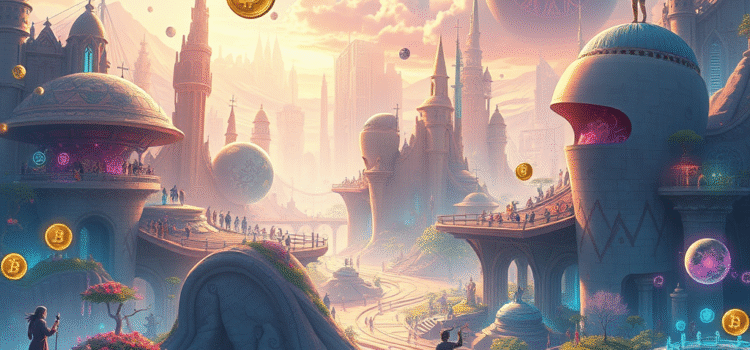
For years, the metaverse has been the tech industry’s favorite buzzword — a blend of virtual reality, gaming, and social interaction that promised a new digital frontier.
But after the hype cooled and the VR goggles gathered dust, something interesting happened: the metaverse quietly started to evolve — not as a single virtual world, but as an ecosystem of interconnected digital spaces powered by Web3 technology.
The next version of the internet won’t just be 3D — it’ll be owned, decentralized, and interoperable.
Here’s how Web3 is breathing life back into the metaverse in 2025 — and what comes next.
From Walled Gardens to Open Worlds
Early metaverse projects like Meta’s Horizon Worlds and Roblox introduced millions to immersive virtual environments.
But they carried the same old Web2 problem: centralized control.
- Your avatar, your items, and your currency all belong to the platform.
- Assets can’t move between ecosystems.
- Creators have limited ownership and revenue rights.
Web3 fixes this by introducing true digital property rights — turning virtual assets into verifiable, transferable tokens on the blockchain.
In short: the metaverse becomes an economy of ownership, not just an experience.
The Web3 Layer: Powering the Open Metaverse
Web3 adds three essential layers that make the metaverse more than a game:
1. Digital Ownership Through NFTs
Non-fungible tokens (NFTs) allow users to own avatars, skins, virtual land, and collectibles across platforms.
Ownership becomes portable and tradeable — not locked inside corporate databases.
2. Interoperable Economies
With blockchain standards like ERC-721, ERC-1155, and Cosmos IBC, assets can move between games and worlds — enabling shared economies.
3. Decentralized Identity (DID)
Wallets replace usernames, giving users persistent digital identities they fully control.
One ID, one wallet, infinite worlds.
This convergence of ownership, interoperability, and identity is what transforms the metaverse from a novelty into a sustainable digital society.
Why 2025 Is the Turning Point
After years of experimentation, key technologies are finally aligning:
- AR/VR hardware is becoming more affordable (Apple Vision Pro, Meta Quest 3).
- Decentralized infrastructure like Vector Smart Chain and Polygon provide scalable backbones.
- AI integration enhances NPCs, environments, and personalization in real-time.
- Corporate adoption is accelerating — with retail, real estate, and entertainment entering Web3-native experiences.
We’re moving from the concept phase to the connection phase — where worlds, economies, and assets begin to link together through blockchain interoperability.
Real-World Examples of Web3 Metaverses
- The Sandbox: User-generated virtual land economy powered by Ethereum and Polygon.
- Decentraland: A community-owned world where players govern via a DAO.
- Somnium Space: Fully VR-enabled world integrating on-chain land and NFT assets.
- Spatial & Mona: Web3 platforms for 3D creative collaboration and NFT art galleries.
- VectorVerse (VSC): The upcoming metaverse layer on Vector Smart Chain — designed for sustainable virtual economies and carbon-neutral commerce.
Each project represents a different piece of the puzzle — and together, they’re forming the blueprint for the open metaverse.
How Vector Smart Chain Bridges the Web3 + Metaverse Future
The metaverse needs fast, affordable, and scalable infrastructure — something most legacy blockchains struggle with.
That’s where Vector Smart Chain (VSC) steps in.
VSC provides the ideal environment for metaverse builders:
- ⚡ Flat-Rate Gas Model: A predictable $4 transaction fee ensures stable costs for creators minting assets or users trading virtual items.
- 🌐 EVM + Cosmos Compatibility: Cross-chain interoperability allows assets to move freely between ecosystems.
- 🌿 Green Infrastructure: Carbon-neutral operations and on-chain carbon credit integration support sustainable virtual economies.
- 🏗️ Enterprise Modules: Built-in tools for tokenization, governance, and asset management simplify metaverse project development.
- 🪪 Digital Identity Support: Integration of decentralized identity (DID) for cross-platform avatars and account authentication.
In short, VSC acts as the foundation for the open, interoperable metaverse — connecting experiences, economies, and users across chains.
The Metaverse Economy of 2025
The fusion of Web3 and the metaverse is giving rise to entirely new markets:
- Virtual Real Estate: Tokenized land parcels with real-world utility and value.
- Digital Fashion: NFTs representing wearable skins across multiple platforms.
- Creator Economies: Independent artists, musicians, and developers earning directly from audiences.
- Work & Collaboration Spaces: Blockchain-secured virtual offices with on-chain payroll.
- Green Metaverse Commerce: Eco-friendly marketplaces backed by carbon offsets on VSC.
By 2025, analysts expect the metaverse economy to surpass $500 billion, with blockchain-native platforms leading growth.
The Challenges Ahead
Even with progress, there are still hurdles to overcome:
- Lack of interoperability standards across major metaverse platforms.
- High entry costs for 3D world creation.
- Regulatory uncertainty around NFTs and digital assets.
- User onboarding complexity for non-crypto natives.
But as Web3 continues to simplify UX (with wallet abstraction, fiat onramps, and identity standards), the metaverse will become as accessible as today’s social media — with infinitely more freedom.
🧠 WTF Does It All Mean?
The metaverse isn’t dying — it’s decentralizing.
Web3 is transforming virtual worlds into interconnected economies where people truly own their assets, identities, and communities.
Chains like Vector Smart Chain are building the rails to make that vision possible — offering sustainable, interoperable, and enterprise-ready infrastructure for metaverse creators and users alike.
Because the future of the metaverse won’t belong to a single company — it’ll belong to everyone who logs in.
TL;DR:
Web3 is powering the next evolution of the metaverse through ownership, identity, and interoperability. With scalable infrastructure and green economics, Vector Smart Chain is positioned to be the backbone of tomorrow’s open virtual worlds.
Key Takeaways
- 1Web3 transforms the metaverse from a centralized gaming experience into an interconnected, user-owned digital economy.
- 2Non-fungible tokens and decentralized identity provide the technical foundation for portable, cross-platform virtual assets.
- 3Scalable, green blockchain infrastructure is essential for supporting sustainable virtual commerce and digital collaboration.
- 4The 2025 metaverse focuses on the connection phase, linking disparate virtual worlds through blockchain interoperability.
Frequently Asked Questions
How does Web3 change the metaverse experience?
What role does decentralized identity play in the metaverse?
What makes an open metaverse different from earlier versions?
Related Glossary Terms
Metaverse
The metaverse refers to a collective, persistent, three-dimensional virtual space that acts as a digital evolution of the internet. It is characterized by immersive environments, social connectivity, and the ability for users to interact through avatars. In the context of blockchain, the metaverse integrates decentralized technology to enable true digital ownership, persistent identities across disparate virtual worlds, and an interoperable economy where goods and services can move freely between different platforms.
Virtual Land
Virtual land is a digital plot of space within a metaverse or blockchain-based game, represented as an NFT. These parcels are finite in supply and exist on a blockchain, providing the owner with verifiable proof of ownership. Similar to real-world real estate, virtual land owners can develop structures, host events, rent out their space, or sell their parcels on secondary marketplaces, effectively acting as landlords within the digital ecosystem.
ERC-1155
ERC-1155 is a multi-token standard that allows a single smart contract to manage both fungible (like currencies) and non-fungible (like unique items) tokens simultaneously. This standard is highly gas-efficient because it allows for batch transfers of multiple tokens in a single transaction. It is widely used in gaming and complex dApps where a user might need to hold thousands of different items, such as weapons, health potions, and currency, all within one inventory system governed by a single contract.
ERC-721
ERC-721 is the standard for non-fungible tokens (NFTs) on the Ethereum blockchain. Unlike ERC-20 tokens, which are interchangeable, every ERC-721 token is unique and distinct, identified by a specific 'Token ID' within a smart contract. This standard allows developers to track, own, and transfer unique digital items such as artwork, collectibles, or digital identity assets. By providing a uniform interface, it enables marketplaces like OpenSea to support an infinite variety of distinct items using a single architecture.
Keep learning
Explore more in Web3