
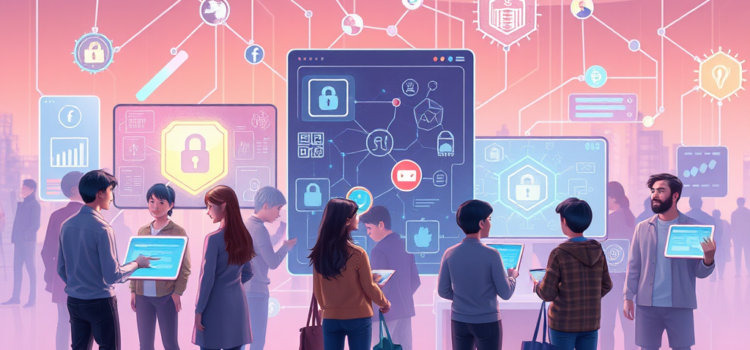
Social media has been a cornerstone of digital communication, but traditional platforms have faced growing criticism over issues like data exploitation, censorship, and centralized control. Enter Web3 social media platforms—decentralized alternatives that prioritize privacy, data ownership, and user empowerment. By 2025, these platforms are reshaping how people engage online, offering a new paradigm for social interactions.
1. What Makes Web3 Social Media Different?
Web3 social media platforms leverage blockchain technology to decentralize data storage and governance, ensuring that users, not corporations, control their digital presence.
Key Features:
- Data Ownership: Users retain full ownership of their data and decide how it’s shared or monetized.
- Decentralized Governance: Platforms operate under decentralized autonomous organizations (DAOs), where users vote on policies and updates.
- Enhanced Privacy: Blockchain encryption ensures secure and private communications.
- Interoperability: Users can port their profiles, content, and followers across platforms seamlessly.
2. How Decentralized Platforms Empower Users
2.1. Ownership of Content
- Traditional platforms monetize user-generated content, often without equitable rewards.
- Web3 platforms allow users to mint their content as NFTs, enabling direct monetization.
- Example: Creators on Web3 platforms can sell exclusive content to followers as NFTs, retaining royalties on resales.
2.2. Privacy-First Design
- Unlike traditional platforms that monetize user data, Web3 platforms prioritize user privacy.
- Example: Encrypted messaging apps like Status ensure that only intended recipients can access conversations.
2.3. Censorship Resistance
- Decentralized platforms are less susceptible to censorship because no central authority controls the content.
- Example: A DAO-driven network might require community consensus to remove posts, ensuring transparency and fairness.
3. Popular Web3 Social Media Platforms in 2025
3.1. Lens Protocol
- Overview: A decentralized social graph enabling users to own their social connections and profiles.
- Key Feature: Interoperable profiles that work across multiple dApps.
3.2. DeSo (Decentralized Social)
- Overview: A blockchain built specifically for scaling social media applications.
- Key Feature: On-chain profiles and microtransactions for creators.
3.3. Mastodon
- Overview: A federated platform offering decentralized and community-owned social networking.
- Key Feature: Independent servers with customizable moderation policies.
3.4. Minds
- Overview: A blockchain-based platform focused on free speech and creator rewards.
- Key Feature: Cryptocurrency rewards for engaging with content.
4. Challenges Facing Web3 Social Media
4.1. User Onboarding
- Many users find blockchain technology intimidating, hindering adoption.
- Solution: Platforms must simplify wallet integration and token usage.
4.2. Scalability
- Storing large amounts of user-generated content on-chain remains challenging.
- Solution: Hybrid models combining blockchain for data integrity and cloud storage for scalability.
4.3. Monetization Models
- Ad-free models rely on token economies, which can be volatile.
- Solution: Develop stable tokenomics and alternative revenue streams like subscription services.
4.4. Regulatory Compliance
- Decentralized platforms must navigate global regulations, especially concerning data privacy and copyright.
- Solution: Collaborate with legal experts to create compliant frameworks.
5. The Future of Web3 Social Media
5.1. Interconnected Ecosystems
- Web3 platforms will integrate seamlessly, enabling users to switch between platforms while retaining their profiles and data.
5.2. AI and Personalization
- AI will enhance user experiences by curating content and managing moderation, aligned with user-controlled preferences.
5.3. Community-Driven Innovation
- Decentralized governance ensures platforms evolve based on user feedback and community needs.
5.4. Tokenized Economies
- Web3 social media will expand tokenized economies, rewarding users for content creation, curation, and engagement.
6. Use Cases Driving Adoption
6.1. Creator Economies
- Creators can earn directly from their audiences through tokenized fan interactions.
- Example: Musicians releasing exclusive tracks as NFTs on decentralized platforms.
6.2. Grassroots Movements
- Web3 platforms empower activists by providing censorship-resistant communication channels.
- Example: DAOs funding and organizing global protests via decentralized networks.
6.3. Niche Communities
- Decentralized platforms cater to niche interests, fostering tighter-knit, value-driven communities.
- Example: A platform for environmental activists that rewards contributions with eco-friendly tokens.
WTF Does It All Mean?
Web3 social media platforms are reshaping online interactions by prioritizing privacy, ownership, and user empowerment. As these platforms continue to evolve, they promise a future where individuals have greater control over their digital identities and interactions. While challenges remain, the potential for decentralized networks to transform the social media landscape is undeniable.
For more insights on Web3 innovations and trends, visit jasonansell.ca.
Key Takeaways
- 1Web3 platforms leverage blockchain to give users full ownership of their data and digital identities.
- 2Decentralized governance through DAOs empowers users to vote on platform policies and development.
- 3Content creators can monetize their work directly by minting posts or media as NFTs.
- 4Interoperability allows users to port profiles and social connections seamlessly across different platforms.
- 5Scalability and user onboarding remain significant hurdles for the mass adoption of decentralized social media.
Frequently Asked Questions
How do Web3 social media platforms differ from traditional platforms?
What is the role of DAOs in Web3 social networks?
Why is interoperability significant in the Web3 social space?
What are the primary obstacles to widespread Web3 social adoption?
Related Glossary Terms
DAO
A Decentralized Autonomous Organization (DAO) is a member-owned, blockchain-based entity characterized by a lack of centralized authority. Operations are governed by smart contracts that automatically execute predefined rules based on transparent, on-chain voting. DAOs coordinate resources and decision-making among geographically dispersed participants, eliminating the need for traditional corporate hierarchies. By leveraging cryptographic transparency, DAOs ensure that every transaction and governance action is verifiable on the public ledger, promoting a high degree of trustless collaboration within decentralized ecosystems and digital protocols.
Storage
In the context of the Ethereum Virtual Machine (EVM), storage refers to a persistent, key-value data store that is unique to each smart contract. Data written to storage is permanently saved on the blockchain, meaning it survives across multiple transactions and function calls. Because storage is the most expensive type of memory operation in terms of gas consumption, smart contract developers must be highly intentional about how they structure and access variables to minimize costs and optimize performance.
Governance
Governance in the blockchain context refers to the framework and processes through which stakeholders in a decentralized system manage protocol updates, parameter changes, and resource distribution. It encompasses both the mechanisms for decision-making and the rules governing how participants interact with the protocol. Effective governance ensures that decentralized networks remain resilient, adaptable, and aligned with community goals. By utilizing tokens or reputation-based voting, governance structures balance the interests of developers, users, and investors to ensure long-term sustainability and security of the decentralized asset.
Decentralized Autonomous Organization (DAO)
An organization governed by smart contracts and on-chain voting, without traditional management structures. DAO members hold governance tokens that give them voting power over proposals. All rules, funds, and decisions are recorded transparently on the blockchain.
Non-Fungible Token (NFT)
A unique digital token that represents ownership of a specific asset. Unlike fungible tokens (where each unit is identical), NFTs are distinct and non-interchangeable. NFTs are commonly used for digital art, collectibles, game items, and representations of real-world assets.
Keep learning
Explore more in Web3