
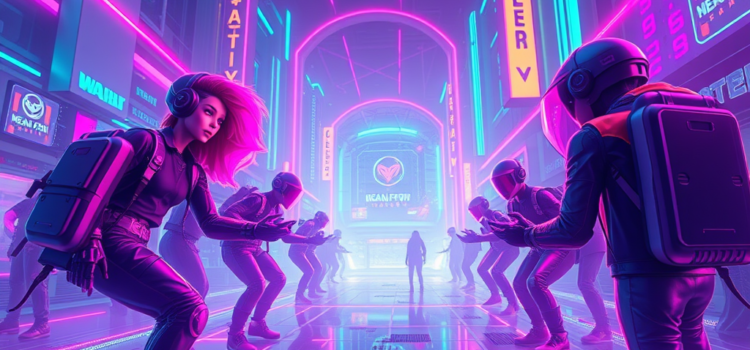
Web3 gaming is evolving beyond speculation, with Play-to-Earn (P2E) and metaverse projects shifting toward real gameplay, sustainable economies, and decentralized ownership. As blockchain gaming matures in 2025, major projects are integrating AI, NFTs, and DeFi mechanics to create immersive, profitable experiences for players.
So, which Web3 games and metaverse platforms are leading the industry in 2025? Let’s explore the biggest Play-to-Earn games, top metaverse projects, and key trends shaping blockchain gaming.
1. Web3 Gaming in 2025: What’s Changed?
🔹 Move-to-Earn & Skill-Based P2E: Play-to-Earn is shifting away from click-to-earn mechanics toward real gameplay incentives.
🔹 AI-Powered NPCs & Environments: Metaverses now feature self-learning AI-driven characters and economies.
🔹 Cross-Chain Gaming Economies: Gamers can now trade assets across different blockchains using interoperability solutions.
🔹 Sustainable Tokenomics: GameFi projects have improved reward models to prevent economic collapses.
📌 What This Means: The best Web3 games are no longer just about earning tokens—they focus on engaging gameplay, player ownership, and real economies.
2. Top Play-to-Earn (P2E) Games in 2025
🎮 1. Illuvium (Ethereum, Immutable X)
✅ AAA open-world RPG with Play-to-Earn mechanics.
✅ On-chain NFT creatures and battles with real economic incentives.
✅ Cross-chain asset integration with Ethereum & Immutable X.
📌 Why It’s Hot in 2025: Expanding into mobile gaming & esports tournaments.
🎮 2. Big Time (Ethereum, Arbitrum)
✅ A multiplayer action RPG with NFT-based time-traveling mechanics.
✅ Limited edition cosmetic NFTs that retain value across seasons.
✅ No gas fees for NFT trades thanks to Arbitrum’s L2 scaling.
📌 Why It’s Hot in 2025: Sustainable in-game economy without pay-to-win mechanics.
🎮 3. Star Atlas (Solana)
✅ Sci-fi strategy MMO with deep space exploration & resource mining.
✅ Dual-token economy: ATLAS (in-game token) & POLIS (governance).
✅ AI-driven in-game economy, adapting prices based on supply/demand.
📌 Why It’s Hot in 2025: Interoperability with other blockchain games via Solana’s DeFi infrastructure.
3. Top Metaverse Projects in 2025
🌐 1. Otherside by Yuga Labs (Ethereum, ApeChain)
✅ The largest NFT-driven metaverse, backed by Bored Ape Yacht Club.
✅ Features AI-powered NPCs that evolve based on player interactions.
✅ Cross-chain asset migration through ApeChain.
📌 Why It’s Hot in 2025: Mainstream adoption & corporate partnerships with major brands.
🌐 2. The Sandbox (Polygon, Ethereum)
✅ Decentralized virtual world with NFT-based land ownership.
✅ User-generated content economy, powered by play-to-earn mechanics.
✅ Major brand integrations (Adidas, Snoop Dogg, Atari).
📌 Why It’s Hot in 2025: Cross-metaverse integrations & AI-enhanced virtual experiences.
🌐 3. Nakamoto Games (Polygon, BSC, Solana)
✅ A multi-chain gaming hub featuring multiple Play-to-Earn games.
✅ Uses $NAKA token for governance, rewards, and DeFi integration.
✅ Features hyper-casual and AAA-style Web3 games.
📌 Why It’s Hot in 2025: Multi-chain NFT support allows in-game assets to move between blockchains.
4. Web3 Gaming Trends to Watch in 2025
🔥 AI-Generated Metaverse Experiences – NPCs and environments adapt to player behavior.
🎮 Cross-Chain Interoperability – Gamers move assets across blockchains seamlessly.
💰 DAO-Controlled Game Economies – Players have voting rights over tokenomics and updates.
🕶 Mixed Reality & VR Integration – Games like Otherside are incorporating Apple Vision Pro & Meta Quest support.
⚡ Gas-Free Gaming Transactions – L2 scaling (Arbitrum, Polygon) removes fees from in-game transactions.
📌 Why This Matters: Web3 gaming is no longer about speculation—games now deliver real entertainment, ownership, and economic opportunities.
WTF Does It All Mean?
Web3 gaming in 2025 is bigger, better, and more sustainable.
✅ Top Play-to-Earn games now emphasize skill, strategy, and real gameplay incentives.
✅ Metaverse projects integrate AI, VR, and brand partnerships for immersive experiences.
✅ Cross-chain gaming enables players to trade assets across multiple blockchains.
The next wave of blockchain gaming is here, and the projects leading the charge are changing how players engage with virtual worlds.
🚀 Which Web3 gaming project are you most excited about?
For more gaming trends, Web3 insights, and blockchain updates, visit jasonansell.ca.
Key Takeaways
- 1Web3 gaming is shifting from pure speculation to focus on high-quality, skill-based entertainment and sustainable economies.
- 2Artificial intelligence is now integral for creating adaptive NPCs and responsive, evolving metaverse environments.
- 3Cross-chain solutions enable seamless asset migration and interoperability between different gaming ecosystems.
- 4Layer 2 scaling solutions are eliminating high gas fees to improve the user experience for casual players.
Frequently Asked Questions
How has the focus of Play-to-Earn games changed in 2025?
What role does artificial intelligence play in modern metaverse projects?
What is cross-chain interoperability in the context of blockchain gaming?
How are gas fees being managed in current Web3 games?
Related Glossary Terms
Web3 Gaming
Web3 gaming refers to a new paradigm of video game development that integrates blockchain protocols to decentralize game assets, economies, and governance. By moving beyond centralized servers, Web3 games utilize distributed ledgers to ensure player-owned items, verifiable rarity, and cross-platform interoperability. This approach fosters a community-driven environment where players participate in decision-making via decentralized autonomous organizations (DAOs), creating a more symbiotic relationship between developers and users.
Play-to-Earn
Play-to-Earn (P2E) is a business model within blockchain gaming that rewards players for their time, skill, and effort within the game. Unlike traditional games where players purchase assets that remain controlled by the publisher, P2E leverages NFTs and fungible tokens to give players actual property rights. Players can generate these tokens through gameplay milestones, competitive play, or resource gathering, which can then be exchanged for other cryptocurrencies or fiat currencies on secondary markets.
Metaverse
The metaverse refers to a collective, persistent, three-dimensional virtual space that acts as a digital evolution of the internet. It is characterized by immersive environments, social connectivity, and the ability for users to interact through avatars. In the context of blockchain, the metaverse integrates decentralized technology to enable true digital ownership, persistent identities across disparate virtual worlds, and an interoperable economy where goods and services can move freely between different platforms.
Arbitrum
Arbitrum is a prominent Layer 2 scaling solution for Ethereum, developed by Offchain Labs. It utilizes Optimistic Rollup technology to bundle thousands of transactions off-chain, compressing them into a single data submission on the Ethereum mainnet. By executing transactions in its own environment and settling the state on Layer 1, Arbitrum drastically reduces gas fees and increases throughput while inheriting the robust security and decentralization guarantees of the underlying Ethereum blockchain.
Keep learning
Explore more in Web3