
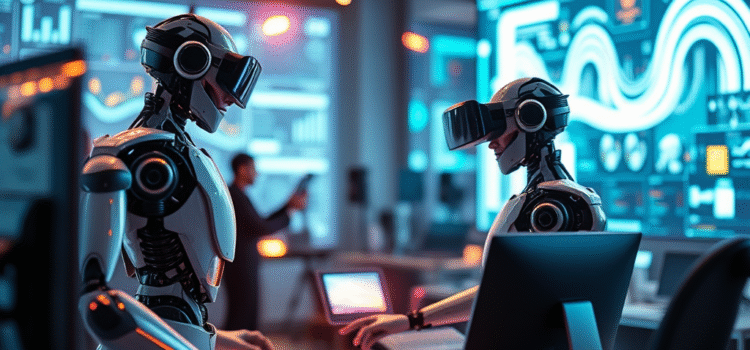
From AI breakthroughs to decentralized networks, 2025 set the stage for the next decade of global innovation.
2025 will be remembered as an inflection point — the year dozens of maturing technologies collided, accelerated, and began reshaping the digital and physical world.
Artificial intelligence leveled up.
Blockchain infrastructure matured.
DePIN went mainstream.
Consumer hardware transformed.
Robotics and automation leapt forward.
And entire industries felt the impact of these breakthroughs simultaneously.
Below is a definitive look at the technologies that shaped 2025 and set the foundation for everything coming in 2026 and beyond.
1. AI Agents Became the New Digital Workforce
2025 was the year of the autonomous AI agent.
AI evolved from passive chat models into:
- task-running workers
- multi-agent collaborators
- automators of business workflows
- code-writing and debugging systems
- on-chain economic participants
Companies began replacing entire departments with AI agent teams, and early AI-native startups emerged with just one founder and dozens of agents running operations.
2025 marked the true start of the AI labor economy.
2. Generative AI Achieved Near-Human Multimodality
LLMs became:
- better reasoners
- image-to-video creators
- real-time voice companions
- tool-using planners
- emotion-aware assistants
With multimodal understanding, AI shifted from “typing answers” to interacting with the real world.
This is the year AI became a universal interface.
3. Mixed Reality Hardware Entered the Mainstream
Apple Vision, Meta’s ecosystem, and new Asian entrants made XR:
- lighter
- sharper
- cheaper
- purpose-driven
2025 was the first time:
- mixed reality workspaces
- AR navigation
- spatial fitness
- immersive telepresence
- 3D collaboration
became everyday use cases.
XR finally crossed into the mainstream consumer market.
4. DePIN Networks Exploded in Adoption
2025 transformed DePIN from niche to necessity.
Users collectively powered:
- decentralized wireless networks
- GPU compute clusters
- distributed storage
- sensor networks
- interoperable IoT infrastructure
People began earning tokens for providing real-world resources, creating the first global, user-owned digital infrastructure layer.
5. Blockchain Moved Into Its Enterprise Era
Legacy chains struggled with fees and unpredictability.
Modern L1s — especially enterprise-ready ones like Vector Smart Chain (VSC) — rose in relevance.
Enterprises adopted blockchain for:
- supply chain authentication
- carbon tracking
- identity frameworks
- tokenized assets
- automated compliance
- secure audit trails
Flat-fee and high-performance chains created new standards for predictability and security.
6. Real-World Assets (RWAs) Became a Trillion-Dollar Narrative
Tokenized RWAs surged across:
- real estate
- treasuries
- commodities
- renewable energy credits
- private equities
AI automated due diligence, onboarding, valuation, and compliance.
Blockchain ensured auditability and instant settlement.
2025 was the first year RWAs felt inevitable.
7. Robotics and Automation Hit a Breakthrough
Robots became:
- more dexterous
- cheaper
- more autonomous
- controlled by AI agents
- capable of learning in real time
Manufacturing, warehousing, agriculture, and logistics all saw major automation upgrades.
2025 was the beginning of hyper-automation across physical industries.
8. Edge AI Hardware Delivered Private, Local Intelligence
Smartphones, headsets, and smart home hubs began shipping with:
- on-device language models
- private inference chips
- instant multimodal reasoning
- offline agent capabilities
The cloud remained powerful, but intelligence moved to the edge — closer to the user.
9. The Car Became a Fully Intelligent Computing Device
2025 vehicles integrated:
- always-on AI copilots
- real-time sensor fusion
- predictive maintenance
- AR dashboards
- autonomous navigation systems
- integrated smart home syncing
Cars became an extension of the user’s digital ecosystem.
10. Quantum Computing Crossed a New Threshold
While not yet dangerous, advances in:
- error correction
- photonic qubits
- hybrid quantum-AI models
signaled that post-quantum security planning must begin now.
2025 was the year organizations took the quantum threat seriously.
WTF Does It All Mean?
2025 wasn’t just another year of tech progress — it was a convergence year, where advancements in AI, blockchain, XR, robotics, edge computing, and DePIN amplified each other.
The key takeaways:
- AI became autonomous
- Blockchain matured into critical infrastructure
- XR became practical
- DePIN created global user-owned networks
- RWAs exploded
- Automation accelerated across industries
- Edge computing put AI everywhere
- Quantum breakthroughs kicked off the security race
Everything that will define 2026 and beyond was born — or solidified — in 2025.
Key Takeaways
- 1Autonomous AI agents emerged as a powerful new digital workforce across various business sectors.
- 2Decentralized Physical Infrastructure Networks (DePIN) successfully transitioned from niche projects to mainstream global adoption.
- 3Enterprises increasingly leveraged high-performance blockchain networks for supply chain transparency and asset tokenization.
- 4Mixed reality hardware and edge computing matured to become practical tools for everyday professional and consumer use.
- 5Convergence between AI, robotics, and blockchain technology accelerated innovation across physical and digital industries.
Frequently Asked Questions
What role did autonomous AI agents play in 2025?
How did DePIN change the landscape of digital infrastructure?
Why did enterprises adopt blockchain technology in 2025?
What defined the shift toward Real-World Assets (RWAs) in 2025?
Related Glossary Terms
AI Agent
Software that uses artificial intelligence to perceive information, make decisions, and perform actions toward defined objectives.
RWA
RWA, or Real World Assets, refers to physical or financial assets that exist outside of the blockchain but are represented on-chain via tokenization. This category encompasses a vast spectrum, including real estate, precious metals, treasury bills, corporate bonds, and carbon credits. By bringing these assets on-chain, investors can trade them in the decentralized finance (DeFi) ecosystem, effectively bridging traditional finance (TradFi) with the speed, transparency, and global reach of decentralized networks.
Authentication
In the Web3 paradigm, authentication is the process of verifying a user's identity and control over a specific blockchain address without the need for traditional usernames or passwords. By using a private key to sign a piece of data, a user can cryptographically prove ownership of their account to any dApp. This process is secure, private, and portable, allowing users to carry their identity and reputation across various applications without creating disparate accounts or disclosing sensitive personal information to third-party servers.
Keep learning
Explore more in Technology