
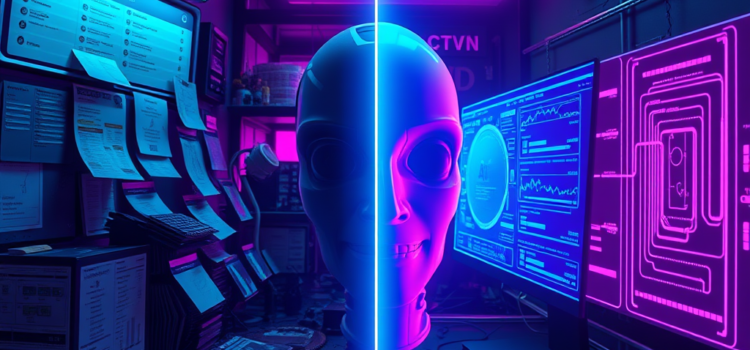
For decades, software has followed the same basic model:
- open an app
- navigate menus
- click buttons
- manually execute tasks
This structure defined how we interact with technology.
But it’s starting to break.
Not because software is failing —
but because a new interface is emerging.
👉 AI agents.
From Interfaces to Outcomes
Traditional software is built around interaction.
You:
- search
- click
- configure
- repeat
AI agents change this completely.
Instead of interacting with software, you define outcomes:
- “summarize this”
- “build this”
- “analyze this”
- “execute this process”
The system handles the steps.
The interface disappears.
What an AI Agent Actually Is
An AI agent is not just a chatbot.
It is:
- goal-driven
- context-aware
- capable of taking actions
Instead of answering questions, it can:
- perform tasks
- interact with systems
- automate workflows
- make decisions within constraints
This shifts software from passive tools → active systems.
This is part of a broader shift toward systems that execute tasks across multiple tools.
Why Interfaces Are Becoming Friction
Interfaces exist because software requires instructions.
Menus, dashboards, and workflows are:
👉 translations between user intent and system execution
But they introduce friction:
- too many steps
- too many decisions
- too much navigation
AI agents remove this translation layer.
They interpret intent directly.
This is why simpler, more focused tools are increasingly outperforming complex platforms.
The Shift from Navigation to Intent
Historically:
👉 users learned how software works
Now:
👉 software learns what users want
This is a fundamental inversion.
Instead of adapting to tools, tools adapt to users.
Automation Is Not New — This Is Different
Automation has existed for years:
- scripts
- macros
- workflows
- APIs
But these required:
- setup
- structure
- technical understanding
AI agents reduce that barrier.
They allow:
👉 dynamic automation
👉 without rigid configuration
Why This Changes Everything
When interaction disappears:
- software becomes invisible
- workflows compress
- execution accelerates
The value shifts from:
👉 features → outcomes
Users don’t care how something works.
They care that it works.
The Death of the “Dashboard Era”
Many modern tools are built around dashboards:
- analytics dashboards
- admin panels
- SaaS interfaces
But dashboards assume:
👉 users will manually explore and interpret data
AI agents remove that need.
Instead of:
- checking metrics
- filtering data
- interpreting trends
You ask:
👉 “What changed?”
👉 “What matters?”
And get answers.
What This Means for Software Builders
This shift forces a rethink of product design.
Winning products will:
- prioritize outcomes over interfaces
- integrate AI at the core (not as a feature)
- reduce steps, not add them
Losing products will:
- add AI as a layer on top of complexity
- keep legacy interaction models
- increase friction
Why Most AI Tools Miss This
Many current AI tools:
- generate content
- answer prompts
- assist tasks
But they don’t:
👉 take ownership of outcomes
This is why they feel impressive
but not transformative.
The real shift happens when:
👉 systems act, not assist
The System Layer Is Emerging
We are moving from:
- tools → platforms → systems
Where systems:
- coordinate multiple tools
- execute workflows
- adapt in real time
This is where AI agents operate.
What Breaks in This Transition
As interfaces disappear:
- traditional UX patterns lose importance
- feature-based competition weakens
- product differentiation shifts
New challenges emerge:
- trust in automation
- error handling
- transparency
- control vs autonomy
The Role of Human Oversight
AI agents don’t eliminate humans.
They shift the role.
From:
- operator
To:
- supervisor
- decision-maker
- strategist
The work doesn’t disappear.
It changes form.
Where This Is Already Happening
You can already see this shift in:
- AI copilots
- autonomous workflows
- agent-based systems
- API-driven automation
But these are early versions.
The full transition is still unfolding.
What Comes Next
As AI agents mature:
- interfaces will shrink
- workflows will collapse
- software will become ambient
Instead of opening apps:
👉 systems will run in the background
Responding to intent continuously.
WTF does it all mean?
The future of software isn’t better interfaces.
It’s fewer interfaces.
AI agents represent a shift from:
👉 interacting with software
👉 to directing outcomes
And once that shift is complete…
The way we think about “using software”
will feel outdated.
Part of the Technology Reality Series
This article is part of a series exploring how technology is actually evolving.
👉 Explore the full series:
https://jasonansell.ca/technology-reality-how-tech-is-actually-evolving/
Key Takeaways
- 1AI agents transition software from manual, interaction-based tools to goal-driven, outcome-oriented systems.
- 2Traditional user interfaces create unnecessary friction by forcing users to navigate complex menus and dashboards.
- 3Dynamic AI automation removes the need for rigid setups, macros, or extensive technical understanding.
- 4The future of software is characterized by fewer interfaces and more ambient, background execution.
Frequently Asked Questions
What is an AI agent in the context of software interfaces?
How do AI agents change the way users interact with software?
Why are traditional software interfaces considered a form of friction?
How does the role of a human user change with the rise of AI agents?
Related Glossary Terms
Related Learning Paths
Keep learning
Explore more in Technology