
Web3 was built on powerful ideas: decentralization, self-custody, and user empowerment. For the first time, individuals could control their assets without intermediaries, permission, or borders.
But there’s a side of Web3 that rarely gets talked about honestly.
A side where responsibility replaces protection.
A side where mistakes are irreversible.
A side where scams thrive not because people are careless—but because they’re unprepared.
That’s the dark side of Web3.
The Problem Isn’t Crypto — It’s the Education Gap
Every year, billions of dollars are lost to crypto scams. Rug pulls. Phishing attacks. Fake presales. Impersonation scams. Wallet drainers.
The common narrative is that victims were greedy or reckless.
That narrative is wrong.
Most people entering Web3 were never taught:
- How scams actually work
- What red flags look like in decentralized systems
- Why “trustless” doesn’t mean “risk-free”
- How quickly one bad signature can wipe out a wallet
In traditional finance, fraud protection is layered, reversible, and centralized. In Web3, it’s not. Responsibility sits entirely with the user—and that shift happens faster than most people realize.
Why Smart People Still Get Scammed
One of the most dangerous misconceptions in crypto is that scams only target beginners.
They don’t.
Many scams succeed because they exploit:
- Urgency and FOMO
- Authority and social proof
- Familiar interfaces and routine behavior
- Emotional pressure during market volatility
Scams don’t look like scams when they work. They look like opportunities, updates, support messages, or routine wallet interactions.
Understanding why these attacks succeed is just as important as knowing what they are.
Web3 Doesn’t Need Less Participation — It Needs Safer Participation
Avoiding Web3 entirely isn’t the answer. Neither is fear.
What Web3 needs is informed participation—users who understand:
- How to evaluate projects beyond hype
- How to spot extraction mechanisms early
- How to protect wallets through better habits
- How to slow down decisions in high-pressure moments
Education is the missing layer of security.
And that’s exactly why I wrote this book.
Introducing The Dark Side of Web3
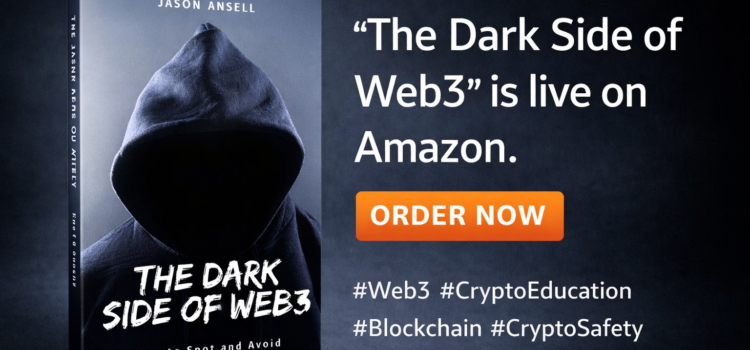
The Dark Side of Web3: How to Spot and Avoid Crypto Scams was written to close the education gap that leaves so many users exposed in decentralized systems.
This isn’t a fear-based book.
It isn’t technical overload.
And it isn’t a collection of sensational horror stories.
Instead, it focuses on:
- The repeating patterns behind modern crypto scams
- Why rug pulls, phishing, impersonation, and wallet drainers work
- The psychology that causes people to ignore warning signs
- A simple due-diligence framework anyone can use
- Practical wallet security habits that reduce risk dramatically
The goal isn’t to scare people away from Web3.
The goal is to help them participate without becoming exit liquidity.
Who This Book Is For
This book is for:
- People new to crypto and Web3
- Investors navigating decentralized platforms
- Builders and community members onboarding others
- Anyone who wants to understand risk before learning it the hard way
If you’ve ever thought, “I wish someone explained this before I started”—this book was written for you.
Where to Get It
📘 Available now on Amazon
- 🇺🇸 https://www.amazon.com/dp/B0GC8MFQQ1
- 🇨🇦 https://www.amazon.ca/dp/B0GC8MFQQ1
- 🇬🇧 https://www.amazon.co.uk/dp/B0GC8MFQQ1
📕 Paperback edition also available
If you’re navigating Web3—or helping others get started—education remains the strongest form of protection.
Because in a trustless system, awareness isn’t optional.
It’s survival.
Key Takeaways
- 1Web3 requires users to take full responsibility for their own security as decentralized systems lack centralized fraud protections.
- 2Crypto scams often succeed by manipulating human psychology rather than just exploiting technical weaknesses.
- 3Informed participation, including better wallet habits and due diligence, is the most effective defense against common threats.
- 4Education is essential to navigate decentralized ecosystems safely and avoid becoming a victim of recurring scam patterns.
Frequently Asked Questions
Why is Web3 security different from traditional finance?
Are only beginners targeted by cryptocurrency scams?
What is the primary cause of high financial losses in decentralized systems?
Related Glossary Terms
Rug Pull
A rug pull is a malicious maneuver where crypto developers abandon a project and run away with investors' funds. This typically happens in decentralized finance (DeFi) projects, where developers create a token, list it on a decentralized exchange, and lure in investors. Once the liquidity pool reaches a sufficient size, the developers withdraw all the paired liquidity (the 'rug'), causing the token's value to crash to zero and leaving investors with worthless assets.
Self-Custody
Self-custody refers to a method of storing digital assets where the user maintains exclusive control over their private keys, thereby negating the need for a third-party intermediary or centralized custodian. By holding the cryptographic keys, the user retains total authority over their funds, ensuring they do not rely on institutional solvency or external permission to authorize transactions or manage assets. This paradigm shift aligns with the core decentralized ethos of blockchain technology, prioritizing individual sovereignty over financial assets.
Phishing
Phishing is a social engineering attack where malicious actors impersonate legitimate platforms, services, or individuals to deceive users into disclosing sensitive information, such as private keys, seed phrases, or login credentials. In the crypto sector, phishing is highly sophisticated; attackers often create fake websites, send fraudulent emails, or use social media bots to trick users into signing malicious transactions that drain their wallets.
Wallet Security
Wallet security encompasses the comprehensive set of practices and technologies used to protect private keys from unauthorized access, theft, or loss. This includes implementing robust backup strategies, utilizing hardware security modules, enabling multi-factor authentication, and maintaining strict digital hygiene to prevent malware, phishing, and social engineering. Effective security relies on the principle that the private key is the ultimate target; therefore, defense-in-depth strategies are required to keep it offline and isolated.
Keep learning
Explore more in Publishing